

Question Sets
Meeting notes are good for a conversation and poor for a trend. A question set asks the same short set of questions every time, so the answers can be compared week to week instead of re-read one paragraph at a time.
A question set is a named, ordered group of questions. Questions live in a shared library, so the same question can appear in more than one question set.
Question sets are turned on for an organization on request, and so is the Feelings question type. To turn either on, email our support team at support@admire.ai.
Build a question set
Section titled “Build a question set”Question sets are set up from Question Sets in the side menu, by anyone allowed to manage them.
-
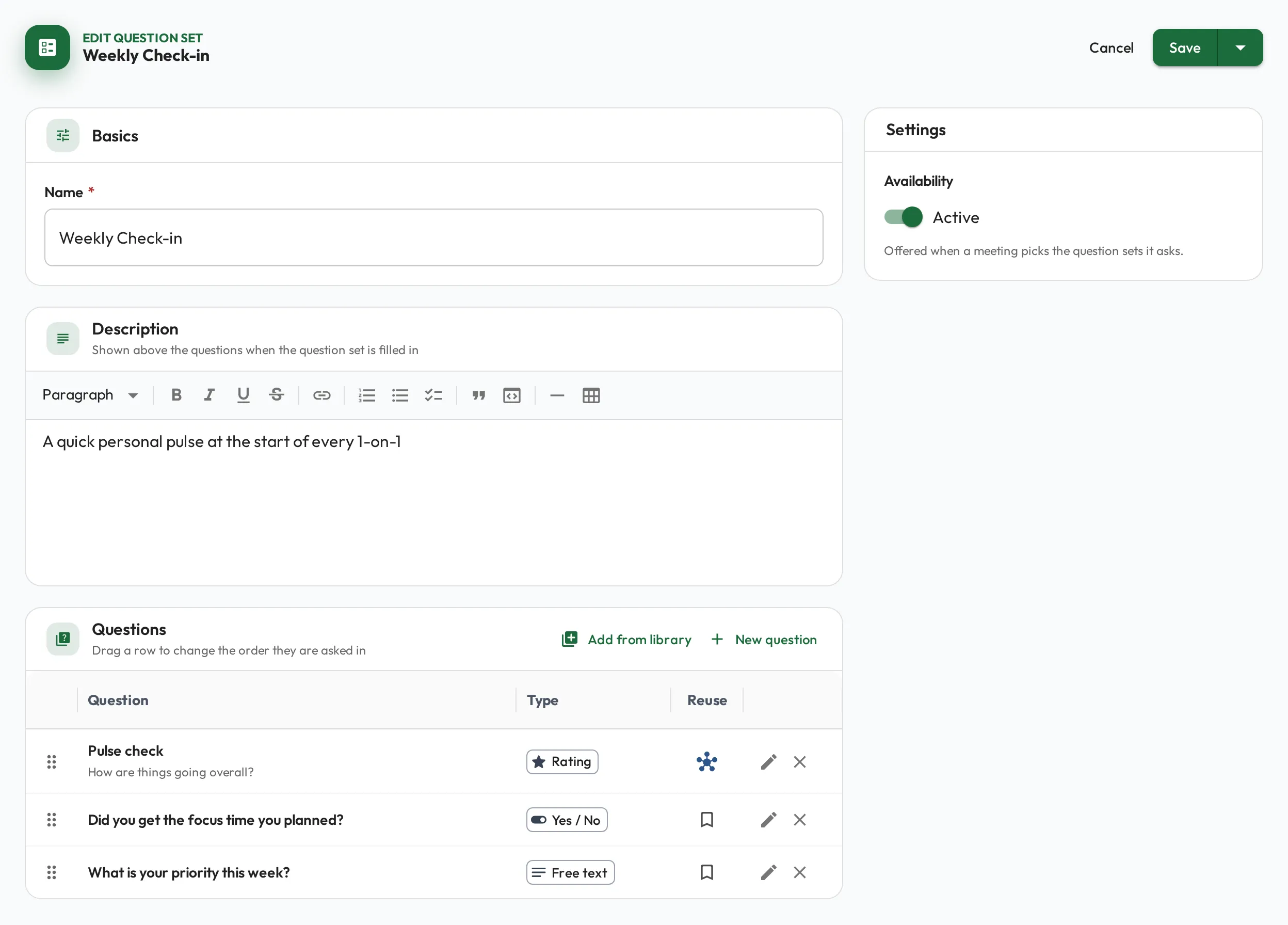
On the Question sets tab, choose Create Question Set and give it a name, and a description if it helps. The description is shown above the questions when someone fills it in.
-
Add questions. Add from library opens the question library so you can pick several at once. New question writes a new one, which joins this question set and the library at the same time.
-
Drag a row to change the order questions are asked in.
-
Leave Availability on Active so Meetings can ask it.
The Questions tab is the library itself. Each question shows its type, the question sets using it, and whether it is still Active, so you can see what an edit will affect before you make it.
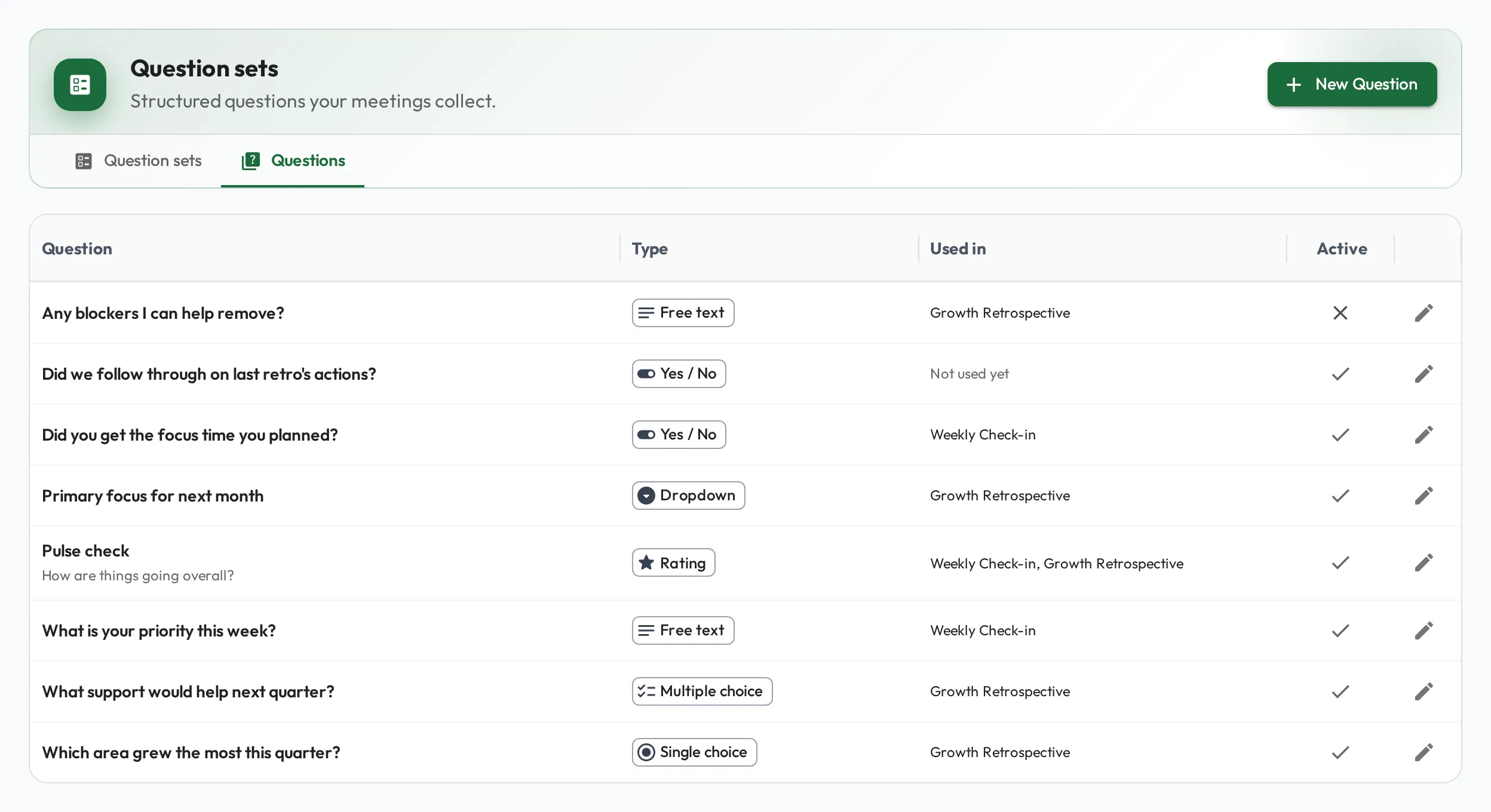
Question types
Section titled “Question types”| Type | The answer |
|---|---|
| Rating | A whole number on a 1 to N scale, tapped |
| Single choice | One option from a list |
| Multiple choice | Any number of options from a list |
| Dropdown | One option, chosen from a drop-down |
| Yes / No | A single toggle |
| Free text | A written answer |
| Feelings | Words picked from the Supporting Lines feelings grid |
The Feelings type uses a fixed vocabulary supplied with Admire, so it carries no choices of its own.
Add a question set to a Meeting
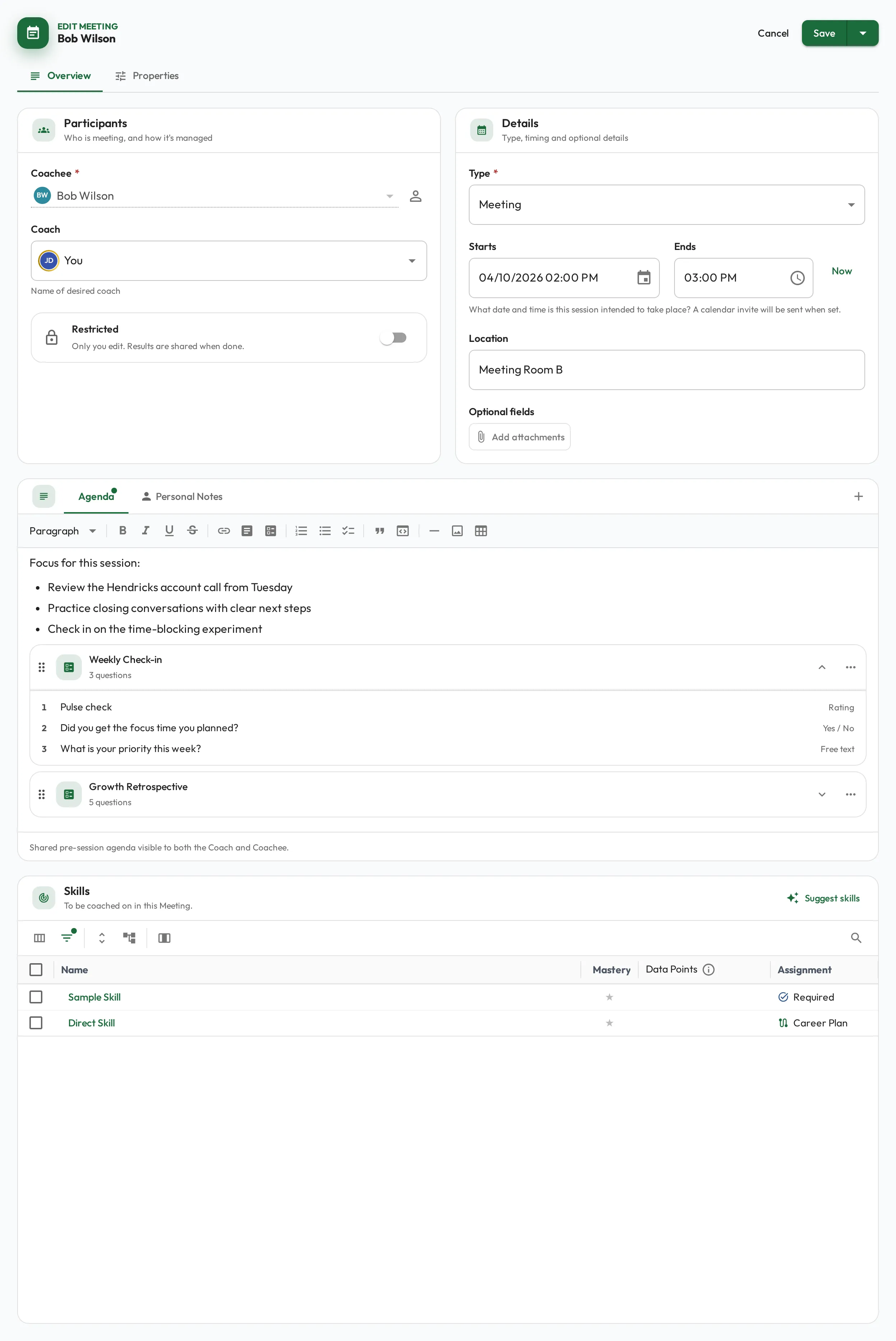
Section titled “Add a question set to a Meeting”A question set lives in the Meeting’s Agenda, as a card on its own line. Where the card sits is where the question set is asked, so the agenda reads as the running order for the Meeting.
Add one while editing the Meeting.
-
Put the cursor in the Agenda where you want the question set asked.
-
Type
/and choose Question set, or use the toolbar’s Insert question set button. Both open the same picker. -
Pick the question set. Only Active ones are offered, and never one this agenda already places.
-
Drag the card by the handle on its left to move it earlier or later in the agenda.
-
Save the Meeting. Nothing is attached until you do.
The card’s ··· menu opens the question set or removes it from the agenda. Choose the chevron to fold the questions open and read them without leaving the Meeting.
Ask the same set at every Meeting of a type
Section titled “Ask the same set at every Meeting of a type”Rather than adding a question set Meeting by Meeting, put it in the Meeting type’s default agenda: every new Meeting of that type then starts with it already placed. It is the same editor and the same picker, opened from Organization → Edit → Customization → Meetings — see Custom fields and Meeting types. Editing a type’s default agenda changes new Meetings only; Meetings that already exist keep what they were given.
Fill one in
Section titled “Fill one in”Question sets appear near the top of the Meeting workspace, above the agenda and notes, for the two people in the Meeting. Every answer saves on its own as you go, so nothing needs submitting.
Both people fill in the same shared set of answers, and each answer is captioned with whoever gave it when it was not you. An answer the other person gives while you have the Meeting open appears within a second or so, and something you are part-way through typing is never overwritten.
The agenda beside them lists each question set as a compact row; choosing it jumps to that question set’s answers.
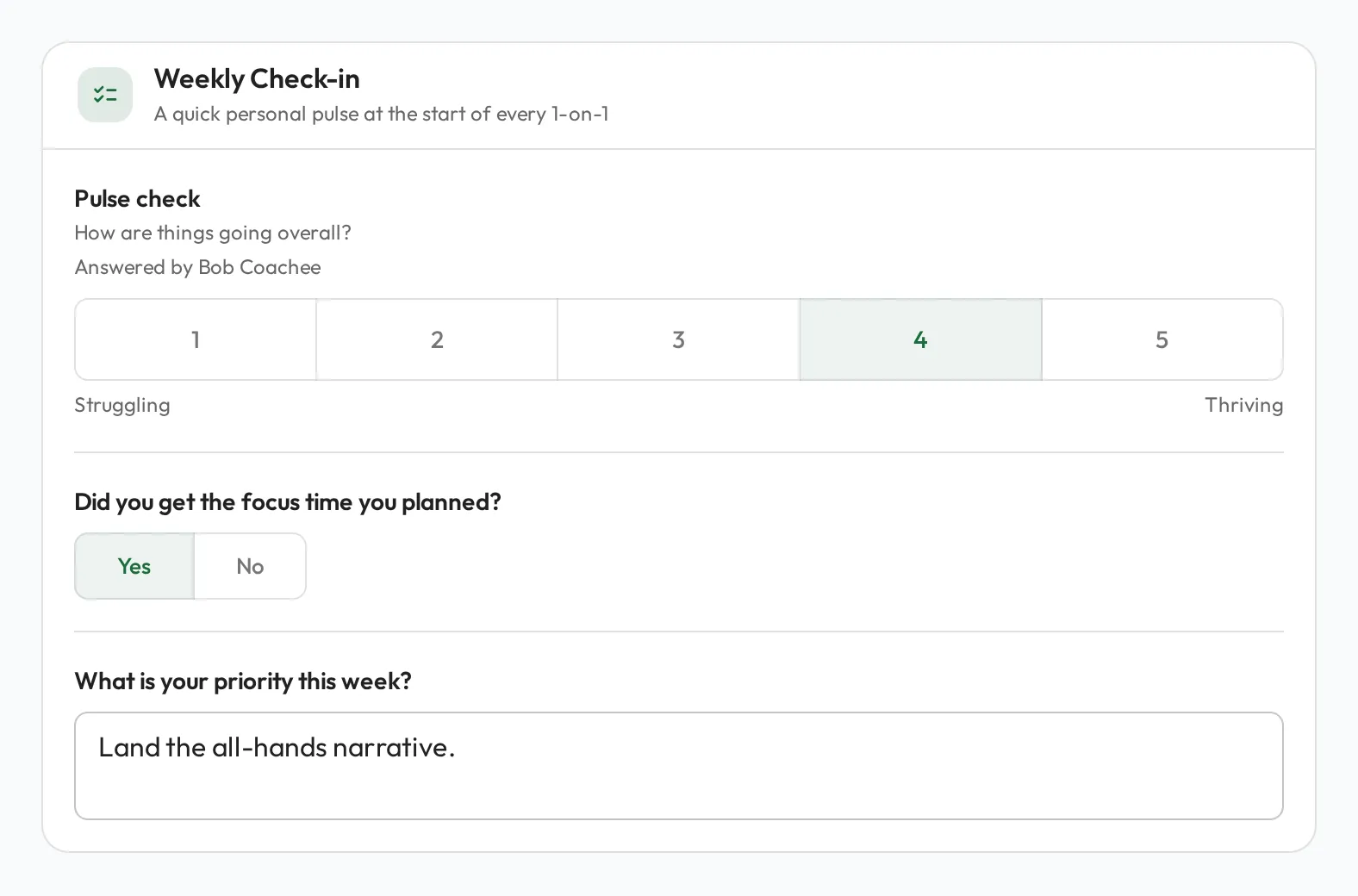
Anyone else who opens the workspace, an administrator or a supervisor reading a finished session, sees the same questions with the answers written out, and Not answered where there is none. The Meeting’s own page lists what it asks in the agenda; open the workspace to read the answers.
Where the answers go
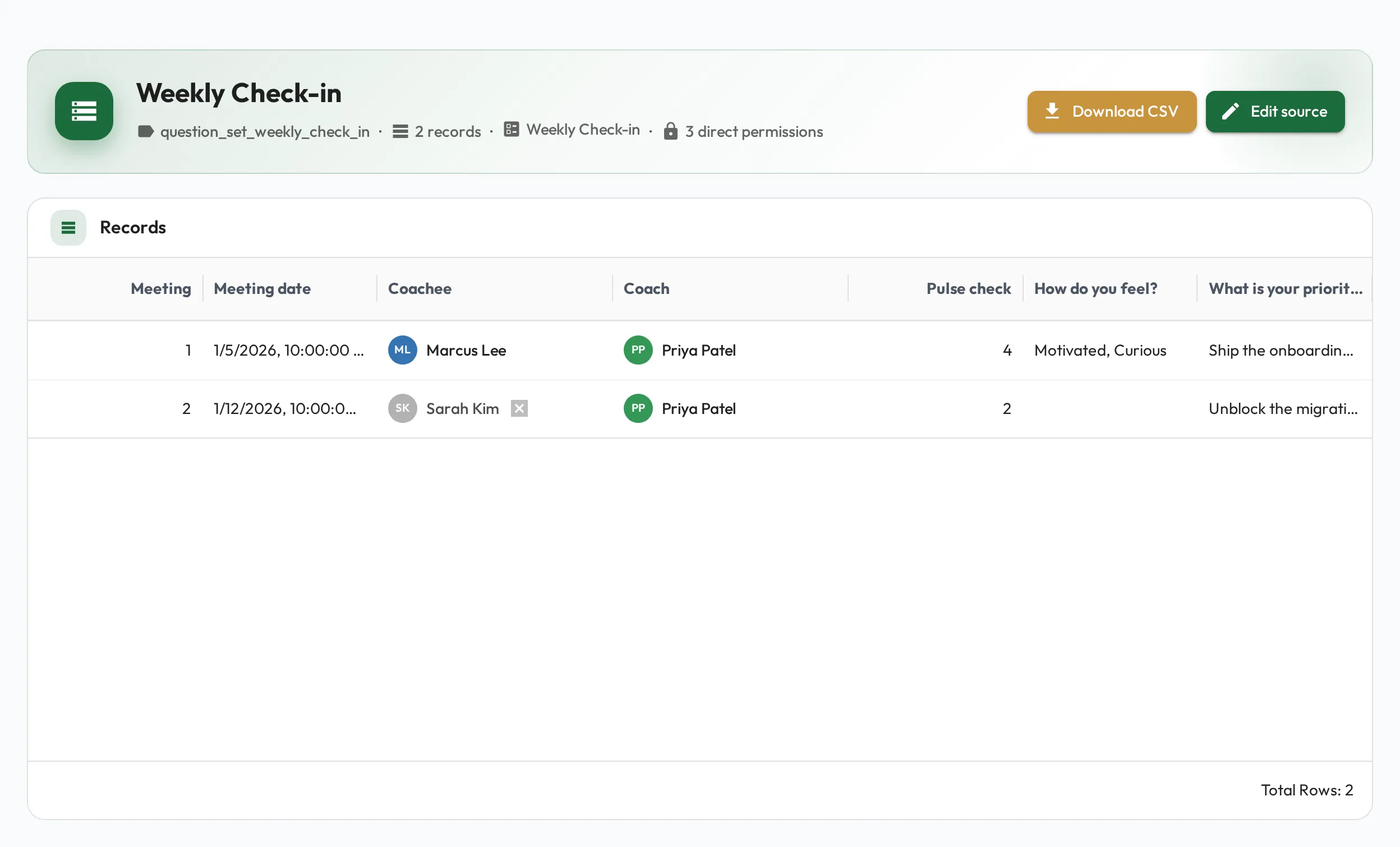
Section titled “Where the answers go”A question set gets a results table under Artifacts, created with the set by anyone who can manage Artifact Sources (see Who can build it): one row per Meeting that answered it, one column per question, and a few more that Admire fills in from the Meeting itself: when it happened, who it was between, and its status. It fills itself as answers are given, so there is no import or refresh step. Rows also update on their own when a Meeting changes: reschedule one, change who it is with, or start or complete it, and its row follows.
Open it from the Responses card on the question set’s page, or from View results on the Question Sets list. The card names the table so you can query it in Reporting. Renaming the question set renames the table, but the name you use in SQL never changes, so a report built on it keeps working.
Each question’s column is named the same way. Leave Reference ID blank on a question and the name comes from its wording; fill it in and that is the name, which is worth doing for anything you expect to write Reporting SQL against. It has to start with a letter and hold only lowercase letters, digits and underscores. Change it later and the column follows, but only while the table is still empty: once a Meeting has answered, remove the results table and create it again to take the new name.
To see it on the Questions tab, open any column heading’s menu and choose Manage columns, then tick Reference ID. The same menu filters and sorts, on both tabs.
You manage this table from the question set. On the Artifacts pages:
- It can’t be uploaded to, emptied or deleted.
- No column can be added.
- The columns Admire writes carry an icon: a question mark for an answer, a linked-dataset mark for a detail filled in from the Meeting. You can reorder these columns, but not delete them.
- You can rename a Meeting-detail column. An answer column takes its name from its question, so rename the question instead.
- A column no longer tied to a question has no icon, and you can edit or delete it.
Everything else that changes the table lives on the question set:
- Rebuild results table empties it and writes it again from the answers on record. Use it if a row ever looks out of date, or to pick up a change the table missed. It asks you to confirm first, because it discards rows of Meetings that no longer ask this question set, anything edited into a row by hand, and values in columns no longer tied to a question.
- Remove results table deletes it and its rows. Answers keep being recorded, and Create results table on the Responses card builds it again from everything already recorded.
Both are in the Manage menu on the question set’s Edit screen, while the table exists.
Deleting the question set does not delete its results table. The table stays under Artifacts as an ordinary source, keeping every row, and its question columns become ordinary columns you can rename, retype or delete.
Deactivating a question set
Section titled “Deactivating a question set”Setting Availability to Inactive stops the question set being offered to new Meetings. Meetings that already ask it, and everything already answered, are untouched.
Retiring a question
Section titled “Retiring a question”Setting a question’s Availability to Inactive stops it being asked. It is no longer offered when a question set adds questions, and Meetings stop putting it to anyone, including Meetings whose question set still lists it. The exception is a Meeting that already has an answer to it: there the question stays on the card, and the answer can still be changed while the Meeting is open. A Meeting that never answered it simply stops listing it.
The question keeps its place in every question set that asks it, marked Inactive on the question set’s page and in the Meeting agenda’s card, so you can see why it stopped appearing and turn it back on.
Removing a question from a question set is different: the question set stops asking it, and the answers already given to it there are hidden for as long as it is out of the question set. Nothing is deleted, and adding the question back brings them into view again. If any answers have been given, Admire asks you to confirm and points you at marking the question Inactive instead. Removing a question never deletes it from the library.
Its column in the results table stays too, values and all, and becomes an ordinary column you can rename, retype or delete. Add the question back and it reconnects to that column only if the column’s Reference ID and JSON path are unchanged, and the question still has the Reference ID the column was named from (or, if it has none, the same wording). Otherwise the question gets a new column and the old one stays where it is.